
A beautiful steel blade can look impressive, but its real quality is revealed through everyday use. Two knives made from similar materials may perform differently, even when they share the same shape and finish. One might maintain its sharp edge for longer, while the other becomes dull or develops small chips. Much of this difference can come from how the steel was heat treated.
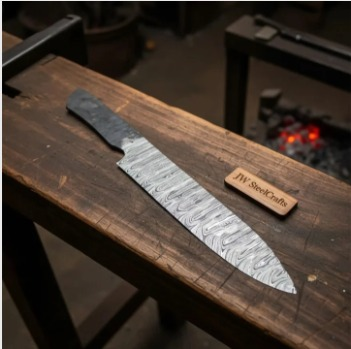
For anyone interested in custom knife making, understanding this process is just as important as choosing attractive materials. You can explore a handcrafted Damascus chef knife blank to see how patterned steel is used in custom blade projects. However, the appearance of Damascus steel alone cannot tell you everything about its hardness, toughness, or long-term performance.
Heat treatment changes the internal structure of steel through controlled heating and cooling. When performed correctly, it can create a useful balance between hardness, toughness, wear resistance, and durability. Understanding these changes helps craftspeople choose suitable materials and recognize what makes a well-made steel product reliable.
What Is Heat Treatment and Why Does It Matter?
Heat treatment is a controlled manufacturing process that changes the physical and mechanical properties of steel without necessarily changing its overall shape or chemical composition.
The process involves heating steel to a specified temperature, maintaining suitable conditions, and cooling it according to the requirements of the material.
Steel contains iron, carbon, and sometimes other alloying elements. Its internal structure determines how it responds to pressure, friction, impact, and deformation.
When steel is heated and cooled under different conditions, its microstructure can change. These transformations influence several properties:
- Hardness: Resistance to indentation and permanent surface deformation.
- Toughness: Ability to absorb energy before fracturing.
- Strength: Ability to resist applied stress without failure.
- Wear resistance: Ability to withstand material loss caused by friction or abrasion.
- Ductility: Ability to deform without breaking.
- Dimensional stability: Ability to maintain the required shape and measurements.
For cutting tools, these properties are particularly important because the blade must resist deformation while maintaining enough toughness to avoid breaking during normal use.
Heat treatment allows manufacturers to adjust these characteristics according to the intended application.
Understanding the Main Types of Steel Heat Treatment
Different heat treatment methods produce different results. Some increase hardness, while others soften steel or improve its suitability for further manufacturing.
Annealing: Making Steel Easier to Work With
Annealing generally involves heating steel under controlled conditions and allowing it to cool slowly.
Its primary purpose is often to soften the material, improve ductility, reduce certain internal stresses, and make machining or shaping easier.
Annealed steel can be useful when craftspeople need to:
- Cut or drill unfinished components.
- Shape steel before final processing.
- Reduce problems caused by previous cold working.
- Prepare suitable materials for additional manufacturing operations.
For example, a knife maker may prefer to shape and drill an annealed steel blank before it receives its final hardening treatment.
However, annealing does not normally create the hardness required for a finished cutting edge.
Normalizing: Improving Structural Consistency
Normalizing involves heating suitable steel above its critical transformation range and allowing it to cool in air.
This process can help refine the microstructure and improve consistency after certain forging or manufacturing operations.
Normalizing may also reduce the effects of uneven processing and prepare steel for later treatments.
The resulting properties depend on the steel grade and the conditions used. Normalized steel is not necessarily softer than annealed steel.
Quenching: Increasing Steel Hardness
Quenching is an important stage in hardening many carbon and alloy steels.
After suitable heating, steel is cooled rapidly enough to produce a harder microstructure. In many hardenable steels, this involves the formation of martensite.
Martensite is associated with high hardness and strength, making it valuable for cutting tools and components that must resist deformation.
However, rapid cooling can also introduce internal stresses.
If the treatment is inappropriate for the steel grade or component shape, problems such as cracking, warping, or excessive brittleness may occur.
Quenching alone does not guarantee a durable finished product.
Tempering: Balancing Hardness With Toughness
Tempering commonly follows quench hardening.
During tempering, hardened steel is reheated below its critical transformation temperature to modify its microstructure and reduce stresses.
This process generally sacrifices some hardness to improve toughness, ductility, and dimensional stability, although the exact response depends on the alloy and treatment conditions.
For knife blades, tempering is particularly important because an extremely hard but brittle edge may chip or fracture under ordinary working conditions.
Proper tempering helps achieve a more practical balance between cutting performance and resistance to damage.
How Heat Treatment Influences Knife Hardness and Durability
The performance of a knife depends on more than the type of steel used. Heat treatment, blade geometry, intended application, and finishing quality also influence how the finished tool behaves.
When comparing different knife blade blanks, makers should consider whether the steel has already been heat treated, what processing remains necessary, and whether the material is appropriate for the intended project.
Hardness and Edge Retention
A properly hardened knife blade can resist deformation along its cutting edge.
This matters because a cutting edge experiences repeated pressure and friction. If the steel is too soft for its intended use, the edge may roll or deform relatively quickly.
Higher hardness often improves resistance to deformation and can contribute to edge retention.
However, edge retention also depends on wear-resistant carbides, blade geometry, sharpening, and the materials being cut.
Hardness alone cannot predict how long a knife will remain sharp.
Toughness and Resistance to Chipping
Toughness describes how well steel resists cracking or breaking when subjected to stress or impact.
A blade with insufficient toughness may develop chips, particularly when it encounters hard materials or experiences sideways pressure.
Increasing hardness can reduce toughness in many steels, but the relationship is not identical across different alloys.
A well-treated blade must maintain enough toughness for the work it is designed to perform.
Wear Resistance and Everyday Durability
Wear resistance affects how steel handles repeated friction and abrasion.
For kitchen knives, wear resistance contributes to cutting-edge performance during frequent use.
For other steel tools, it may influence the durability of surfaces exposed to rubbing or contact.
The steel’s chemical composition, carbide structure, hardness, and processing history all influence wear resistance.
A properly selected heat treatment helps the material achieve useful performance without sacrificing other essential properties.
Structural Stability
Heat treatment can also affect whether a steel component maintains its intended shape.
Uneven heating, unsuitable cooling conditions, or internal stresses may contribute to distortion.
Thin blade sections can be particularly sensitive because even a small amount of warping may affect alignment, grinding, or the final cutting geometry.
Careful process control helps reduce these risks.
Comparing Steel Heat Treatment Processes
The following table summarizes the common purposes and effects of major steel heat treatment methods.
| Heat Treatment | Typical Effect on Hardness | Main Purpose |
| Annealing | Generally reduces hardness | Improves workability and ductility |
| Normalizing | Depends on grade and prior condition | Refines structure and improves consistency |
| Quench hardening | Often increases hardness significantly | Improves resistance to deformation |
| Tempering | Usually reduces hardness from the quenched condition | Improves toughness and reduces internal stresses |
| Stress relieving | Usually produces limited hardness change | Reduces residual stresses |
These effects are general. Actual results depend on steel composition, prior processing, component dimensions, and treatment conditions.
For knife making, hardening followed by suitable tempering is a common approach. Decorative metalwork, structural components, and precision tools may require entirely different processing methods.
Why Harder Steel Is Not Always More Durable
It is easy to assume that the hardest available steel will also be the most durable.
In reality, hardness and durability are not interchangeable.
Consider two cutting tools with different intended purposes.
A fine kitchen knife designed for precise slicing benefits from an edge that resists deformation and wear.
A heavy-duty tool exposed to impact and rough handling needs greater resistance to fracture.
Both require adequate strength, but their ideal hardness and toughness combinations may differ.
Increasing hardness without considering toughness can make a blade more vulnerable to damage under certain conditions.
A suitable treatment must account for several factors:
- The intended cutting or working application.
- Expected impact and bending stresses.
- Steel composition and microstructure.
- Blade thickness and edge geometry.
- Maintenance and sharpening requirements.
The best steel is not necessarily the one with the highest hardness rating. It is the one whose properties match its intended use.
What Does HRC Mean in Knife Steel?
HRC refers to the Rockwell C hardness scale, a standardized method commonly used to measure the hardness of hardened steels.
The measurement is based on how deeply a specified indenter penetrates the material under controlled test loads.
A higher HRC value generally indicates greater resistance to indentation.
For many kitchen knives, hardness values around 58 to 63 HRC are common, although suitable ranges vary by steel grade, blade design, and intended use.
Does Higher HRC Mean Better Edge Retention?
Not automatically.
Higher hardness can improve edge stability and wear resistance, but cutting performance also depends on the steel’s carbide composition and the geometry of the cutting edge.
Two blades with the same HRC rating can have different toughness and wear resistance.
Likewise, two blades made from the same steel can perform differently because of differences in their heat treatment.
Why Is HRC Not Enough to Judge Quality?
A hardness measurement provides valuable information, but it does not reveal every important property.
It cannot independently confirm:
- Impact toughness.
- Resistance to cracking.
- Carbide distribution.
- Quality of the complete heat treatment.
- Edge geometry or sharpening performance.
- Corrosion resistance.
For this reason, hardness ratings should be considered alongside material specifications and the manufacturer’s processing information.
How Heat Treatment Affects Damascus Steel
Damascus steel is particularly interesting because it combines visual craftsmanship with metallurgical considerations.
Modern pattern-welded Damascus steel is generally produced by joining and forging layers of different steels.
The contrasting layers create distinctive patterns that become visible after suitable finishing.
However, the visible pattern should not be confused with proof of mechanical performance.
Does Damascus Steel Require Heat Treatment?
If a Damascus blade is intended to function as a cutting tool, its constituent steels and processing must provide suitable hardness and toughness.
Appropriate heat treatment is therefore an important consideration.
The exact process depends on the alloys used. Different steel combinations can respond differently to heating and cooling.
Without knowing the constituent grades and manufacturing condition, it is impossible to determine an appropriate treatment simply by examining the pattern.
Does Heat Treatment Make Damascus Steel Stronger?
Suitable heat treatment can improve the hardness, strength, and functional properties of a compatible Damascus steel combination.
However, improvement is not guaranteed merely because the material has undergone heating and cooling.
The results depend on material composition, bonding quality, processing conditions, and the intended application.
A decorative Damascus pattern does not establish that a blade has been correctly hardened or tempered.
Why Material Information Matters
When evaluating an unfinished Damascus blade, it is useful to know whether the supplier can identify the constituent steels and heat-treatment condition.
For example, a hand-forged chef knife blank may provide a convenient starting point for a custom handle project, but makers should not assume it requires further hardening or is ready for immediate use without checking its supplied condition.
Verifying these details helps prevent unnecessary processing that could damage an otherwise suitable component.
Common Heat Treatment Problems That Affect Durability
Even high-quality steel can perform poorly when processing conditions are unsuitable.
Several common problems can affect a finished steel product.
Excessive Brittleness
Steel that is hardened without adequate consideration of toughness may become vulnerable to cracking or chipping.
Suitable tempering and correct alloy selection help manage this risk.
Warping and Distortion
Uneven temperature distribution and cooling can cause unwanted dimensional changes.
Distortion is especially troublesome for components requiring accurate alignment or thin, consistent sections.
Inconsistent Hardness
A component may develop uneven mechanical properties if its heating or cooling conditions are inconsistent.
This can create variations in performance across different areas of the material.
Surface Decarburization
Exposure to certain high-temperature environments can cause carbon loss near the steel surface.
In hardenable carbon steels, significant surface decarburization may reduce the achievable hardness in the affected layer.
Controlled processing and appropriate surface preparation help limit this issue.
Cracking From Thermal Stress
Rapid temperature changes can introduce significant stresses.
Poorly matched treatment conditions can cause cracks, making a component unsuitable for its intended use.
These problems demonstrate why heat treatment should be carefully controlled rather than treated as a simple heating operation.
How to Evaluate Heat-Treated Steel Before Buying
You do not need to be a metallurgist to make a more informed steel purchase.
A few practical checks can help identify whether a material is appropriate for your project.
Confirm the Steel Grade
Look for a clearly identified steel grade whenever possible.
Descriptions such as premium steel or high-quality metal do not provide enough information to determine mechanical properties.
Ask About Heat-Treatment Condition
Find out whether the material is supplied annealed, hardened, tempered, or in another specified condition.
This is particularly important for knife blanks because different products may require different amounts of remaining work.
Review Hardness Information
If an HRC rating is provided, compare it with typical requirements for the stated steel and intended application.
Avoid treating a high number as an automatic guarantee of quality.
Inspect for Visible Problems
Check for obvious warping, cracks, significant surface damage, or other defects.
Visual inspection cannot reveal every internal problem, but it can identify reasons for further investigation.
Consider Supplier Transparency
Reliable product information should distinguish between verified material properties and general marketing descriptions.
For demanding applications, ask for appropriate specifications, testing information, or processing documentation.
Can Heat Treatment Improve Rust Resistance?
Heat treatment primarily influences steel’s microstructure and mechanical properties.
It is not generally a substitute for choosing a corrosion-resistant alloy or applying suitable surface protection.
Stainless steels rely heavily on their chromium content and passive surface layer for corrosion resistance.
Certain heat-treatment conditions can affect corrosion behavior in particular stainless grades, but the relationship is complex.
For ordinary carbon steel and many Damascus blades, proper cleaning, drying, and protective maintenance remain important.
A correctly hardened blade can still rust if its composition and environment make it susceptible to corrosion.
Frequently Asked Questions
Does Heat Treatment Increase Steel Hardness?
Yes, appropriate hardening treatments can significantly increase the hardness of compatible steels. The result depends on steel composition, heating conditions, and cooling rate. Not every steel grade responds to hardening in the same way.
What Happens if Steel Is Not Properly Heat Treated?
Improper treatment can leave steel too soft, excessively brittle, unevenly hardened, warped, or cracked. The specific problem depends on the material and processing conditions.
Why Is Tempering Important After Quenching?
Quench-hardened steel can contain significant internal stresses and may have insufficient toughness. Tempering modifies the hardened structure to improve its suitability for practical use.
Is Tempered Steel Stronger Than Untempered Steel?
The answer depends on how strength is measured. Tempering often reduces hardness and some strength from the freshly quenched condition while improving toughness, ductility, and stability. These changes can make the steel more reliable in service.
Does Damascus Steel Hold an Edge Better Than Regular Steel?
Not necessarily. Damascus steel does not automatically provide superior edge retention. Performance depends on its constituent alloys, heat treatment, carbide structure, blade geometry, and sharpening.
Can Two Knives Made From the Same Steel Have Different Hardness?
Yes. Different heat treatments can produce different hardness values even when the steel composition is similar. Manufacturing consistency and testing also influence the reported results.
Does Heat Treatment Affect the Lifespan of a Knife?
Yes. Suitable heat treatment can improve resistance to deformation, wear, and certain types of damage. However, a knife’s lifespan also depends on its design, intended use, sharpening, handling, and maintenance.
Conclusion
Understanding how heat treatment affects steel hardness and durability is essential for anyone interested in metalworking, knife making, or purchasing dependable steel products.
Processes such as annealing, normalizing, quenching, and tempering serve different purposes. Together, they demonstrate how the same material can develop different mechanical properties through controlled processing.
For knife makers, the goal is not simply to achieve maximum hardness. A reliable blade requires an appropriate balance between edge stability, wear resistance, toughness, and structural integrity.
This is especially important when working with handcrafted materials such as Damascus steel, where an attractive surface pattern does not automatically reveal the blade’s mechanical properties.
By considering steel composition, documented heat-treatment condition, hardness measurements, and intended use, craftspeople can make better material choices and create finished products that remain dependable over time.
Ultimately, proper heat treatment is one of the most important factors separating a visually appealing steel component from one that delivers consistent performance and lasting durability.