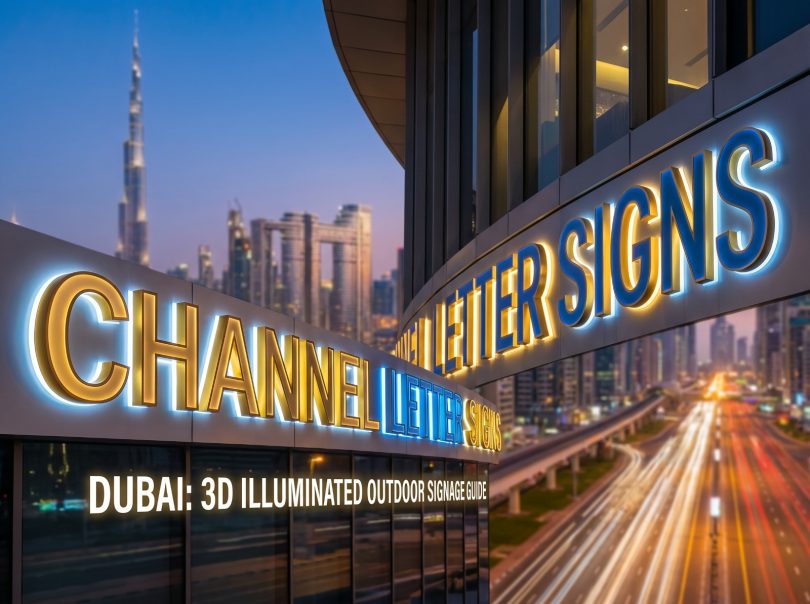

Walk down almost any commercial street in Dubai after dark and you’ll notice the same thing: the signs that actually grab your attention aren’t flat panels lit from behind glass. They’re raised, three-dimensional, and glowing on their own. That’s channel letter signage — individually built letters mounted straight onto a building facade, each one wired and lit independently.
If you’re picking outdoor signage for a storefront, office tower, or retail unit, channel letters are usually the strongest option on the table. But “channel letters” isn’t one product — there are several ways to light them, and the type you pick changes the look, the price, and how much maintenance you’re signing up for down the line.
What Channel Letters Actually Are
Each letter is its own fabricated unit. Aluminum forms the back and sides (fabricators call these the “returns”), and the face is usually acrylic or polycarbonate so light can pass through it. LEDs sit inside, wired to a power source. Because every letter stands on its own rather than being printed on a flat board, the sign has real depth — which is exactly why malls, office towers, and high-street retail across Dubai lean on this format so heavily.
The Different Types — and Why It’s Not Just “Channel Letters”
This is where most people get confused. There isn’t one type of channel letter. There are four, and picking the wrong one for your building or budget is a common (and expensive) mistake.
Front-lit (standard). Light shines straight through the acrylic face. It’s the most common option for a reason — it’s the cheapest to build and the most visible at night. If your priority is being seen from across the street, this is it.
Halo-lit (reverse). Here the face is solid metal, and the letters sit slightly off the wall so light spills out behind them instead of through them. Instead of the letter glowing, you get a soft outline glowing around it. It looks more refined, honestly — but it only works well on lighter-colored building facades. Put a halo-lit sign on a dark wall and the effect basically disappears.
Front-and-back-lit (combination). This one does both at once — the face glows, and there’s a halo behind it too. You pay more for the extra wiring, but you get a sign that reads well whether someone’s standing right in front of it or looking at it from three blocks away.
Open-face. Less common. The LED or neon modules are left visible instead of hidden behind a face. It’s a raw, exposed look — not for everyone, but it fits certain brands well.
For most commercial outdoor signage projects, front-lit is the default. It’s reliable, cost-effective, and holds up fine against Dubai’s harsh daylight glare. Halo-lit and combination options cost more because they need more metal work and extra wiring — worth it if the brand is positioned as premium, overkill if it isn’t.
Why Dubai’s Climate Changes the Materials Conversation
Here’s something a lot of sign buyers don’t think about until it’s too late: what works in a cooler climate doesn’t automatically survive here.
- Aluminum returns need real anodizing or powder coating. Skip that step and the metal degrades faster than you’d expect under constant heat cycling and UV.
- Acrylic faces should be UV-stabilized. Standard acrylic without that protection yellows and turns brittle within a couple of years in direct Dubai sun — not a decade, a couple of years.
- LED modules need a heat rating suited to local summer temperatures. LEDs built for cooler markets run hotter here and burn out sooner than the spec sheet promises.
- Sealing and drainage matter more than most fabricators admit upfront. Dust gets into poorly sealed housings and eventually shorts the wiring.
Cut corners on any of this and it doesn’t show up on day one. It shows up as a maintenance call in year two.
Approval Rules You Can’t Skip
Illuminated outdoor signage in Dubai falls under Dubai Municipality’s advertising regulations, and those regulations cap how bright LED and lightbox signs can be — this exists to control light pollution, not to make your life harder, but it does mean your design has to fit within a limit. Anything over 2.5 metres also triggers a structural review before approval.
Get your channel letter design checked against these limits before fabrication starts, not after. A sign that gets built outside the brightness or size rules doesn’t just get flagged — it gets rejected, and you’re paying for rework on top of the original build.
What Actually Drives the Price
There’s no single number that applies to every channel letter project, whatever a quick Google search tells you. Real cost depends on:
- Letter size and count. Bigger letters, longer business name, higher material and labor cost. Simple as that.
- Illumination type. Front-lit is the cheapest. Halo-lit and combination cost more because of the extra fabrication and wiring.
- Mounting method. Flush-mounting straight onto the facade means more drilling and labor. Raceway mounting — where the letters sit on a single mounted panel — is faster and usually cheaper.
- Return depth. Deeper returns give a stronger 3D look but use more material, so they cost more.
Ask for a quote based on your actual letter count and mounting method. A generic per-letter estimate you saw online won’t reflect what your project actually needs.
Matching the Type to the Business
- Want maximum night visibility on a busy street? Front-lit.
- Running a premium or boutique brand on a light-coloured facade? Halo-lit.
- Need visibility from both close range and a distance on a tall building? Front-and-back combination.
- Working with a tight budget and straightforward branding? Front-lit, standard raceway mounting.
Where Ambert Fits In
Building channel letters that hold up in Dubai’s heat and clear Municipality approval on the first try takes fabrication experience specific to this market. Specs built for a cooler climate simply don’t translate here. As a signage company in Dubai, Ambert Industries fabricates channel letters to the material and brightness standards that pass review the first time, so what gets built is what stays approved.
Frequently Asked Questions
What’s the difference between front-lit and halo-lit channel letters?
Front-lit letters have a translucent face that glows directly outward. Halo-lit letters have a solid face mounted off the wall, so the light spills out behind the letter instead, creating a glowing outline rather than a lit-up face.
How long do channel letter signs last in Dubai’s climate?
With UV-stabilized acrylic, properly finished aluminum, and heat-rated LEDs, expect 5 to 10 years. Cut corners on those materials and that lifespan drops fast — sometimes to a couple of years before the face starts yellowing or the LEDs fail.
Do channel letter signs need Dubai Municipality approval?
Yes, without exception. Illuminated outdoor signage falls under Dubai’s advertising regulations, including brightness caps for LED and lightbox signs. Anything over 2.5 metres also needs a structural review before it’s approved.
Which type of channel letter is the most cost-effective?
Front-lit with standard raceway mounting. It needs less metal fabrication and less wiring than halo-lit or combination designs, which is where most of the added cost in those options comes from.
Can channel letters go on any building facade?
Most facades can take them, but the mounting method depends on the surface and how deep the letters are. Raceway mounting works on most buildings with minimal drilling. Flush mounting needs more structural assessment first.