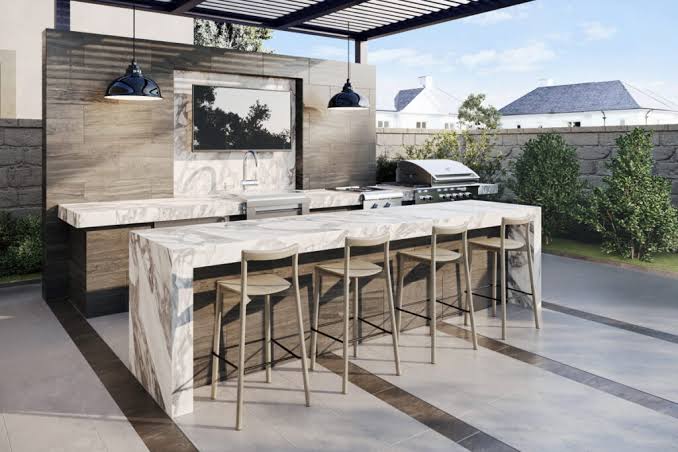

Outdoor kitchens have gone from a barbecue on the deck to a proper second kitchen with a sink, storage and a run of benchtop. That raises a fair question about the surface, because outside it has to deal with sun, rain, salt air and a barbecue running beside it.
Porcelain handles all of that better than most options. It is one of the few surfaces that behaves the same outdoors as it does indoors, which is why it now shows up in so many alfresco areas across Sydney.
Why it suits the conditions
Three things matter outside, and porcelain does well on all three.
The colour is baked into the material and is UV stable, so it does not fade or yellow after a few summers in full sun. The surface is non-porous, so rain, humidity and spilled marinades sit on top rather than soaking in, and nothing needs sealing. And it copes with heat, which matters next to a barbecue hood.
Salt air is worth mentioning for anyone near the coast. A non-porous surface gives salt nothing to work into, so a rinse with fresh water is generally all the maintenance it needs.
How it compares with the alternatives
Marble and limestone are lovely inside and difficult outside. They are porous and react to acids, so lemon juice, wine and even some cleaning products leave dull marks, and rain plus dirt will patina them quickly.
Granite performs well outdoors and has done so for decades, though it needs sealing and a few coloured granites can fade in constant sun.
Engineered stone is not an option for new work in Australia, since its manufacture, supply and installation were prohibited in 2024. Even before that, it was never recommended outdoors because UV exposure can discolour the resin that holds it together.
Thickness and support
This is where outdoor jobs go wrong, so it is worth being specific.
Go and see the porcelain slab Sydney range in 20mm before you decide, rather than the thinner sheets used indoors. Porcelain comes in 6mm for walls and splashbacks, 12mm for most benchtops and 20mm for outdoor use, and outside you want the extra thickness.
The frame underneath needs to be flat, level and continuous, and it needs to be a material that copes outdoors, so marine grade or an aluminium or steel frame rather than standard cabinetry. Cutouts for a drop-in barbecue or sink need rounded, pre-drilled corners, and the appliance manufacturer’s clearance specifications need to be followed exactly.
Living with it day to day
Porcelain is heat resistant, so a hot tray or a tool set down while you cook will not mark it. That said, appliance clearances exist for a reason, and no surface enjoys a red-hot cast iron plate straight off the flames sitting on it for an hour.
Dark colours absorb heat in direct sun and get hot to the touch, exactly as a dark car bonnet does. If the bench is in full afternoon sun, lighter tones are more comfortable to use.
For flooring or pool surrounds the same area, choose a textured finish rather than a polished one. Polished porcelain is slippery when wet.
Cleaning and upkeep
There is not much to it. Warm water and a pH-neutral cleaner handle normal use. No sealing, ever. Grease from cooking wipes off because it cannot soak in, and a stiff brush deals with anything baked on.
Give it a rinse after long gaps between use if you are close to the water, and keep the barbecue itself clean so grease does not build up where the appliance meets the stone.
Frequently asked questions
Will the colour fade in the Australian sun?
No. Porcelain is fired at high temperature and the colour is UV stable, which is one of its main advantages over materials that rely on resins or dyes.
Can I put a hot pan straight onto it?
Yes, for normal cooking use. Porcelain is heat resistant, though it is still sensible to follow the barbecue manufacturer’s clearance requirements around the appliance itself.
Will it crack in extreme heat or cold?
Porcelain is dimensionally stable across the temperature range Australian conditions produce. Cracking outdoors almost always traces back to poor support underneath or a cutout with sharp corners rather than the weather.
Choosing the right slab
Porcelain is a genuinely good fit for outdoor kitchens and barbecue areas, provided the thickness suits the job and the frame under it is built properly. Look at 20mm slabs, check how cutouts will be handled, and think about how much direct sun the bench gets before settling on a colour. Seeing full slabs in person is worth the trip, because pattern and tone read very differently outside in daylight than they do on a screen.